We sat down, re-studied the whole tonewheel phenomenon, and rewrote all the algorithms that made Galileo famous for its sound quality. The result is an all-new organ that sounds warmer, looms larger, and behaves more real than ever before — with AUv3, native processing at any industry-standard sample rate including 96kHz, 64-bit floating point DSP, and a significantly better workflow. Did we forget to mention that Galileo 2 is also universal?
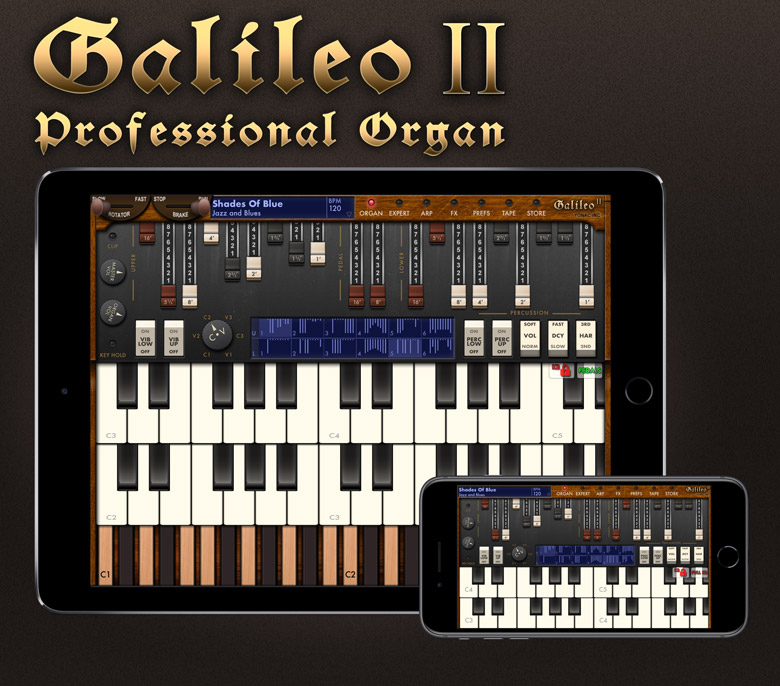
At Galileo 2's core is our very own, brand new virtual-analog technology that generates tonewheel and transistor signals in realtime. Effects of characteristics such as harmonic leakage, waveshapes, frequency response, keyclick, and even tonewheel motor behavior have all been studied and carefully recreated. Galileo 2 also provides a well thought out set of parameters, so that you can easily dial in the tones of an organ of any age or condition. Virtual-tube amplifiers and sophisticated rotary speaker/amp simulations round out the successor of what many consider the best organ on iOS.

All the classic Galileo effects, including the acclaimed RotaryBox, are completely rewritten for greater realism and superior tone — and now fully stereo. Galileo 2 also offers a superb collection of custom effects & amps designed to evoke the best organ tones and expand your sonic palette. FX management just got better too: thanks to the new Galileo 2 virtual signal chain, you can add, remove, or reorder effects, and even run multiple instances of the same unit.

Galileo 2 has gone all AUv3. Just plug it into your favorite iOS DAW and go — run multiple instances at the same time, change patches, adjust parameters, or double up on the fly. MIDI you say? With fully implemented MIDI Learn for the organ and all the FX, keyboard mapping options, program changes and much more, Galileo 2 eats MIDI for breakfast every Wednesday. Inter-App Audio, Audiobus, and Ableton Link are also amply provided.

300+ presets in an eclectic range of styles, a powerful preset management system, backward compatibility with legacy Galileo presets, a versatile arpeggiator with live & two program modes as well as many stepping algorithms, a virtual ribbon controller with poly aftertouch, built-in audio recording, looping & sharing, a metronome, and stage-friendly fullscreen iPad control mode — these are only some of the conveniences that come with playing on a Galileo 2.

Six core effects ship free; ten more are available as upgrades.

The acclaimed classic Galileo rotary speaker simulation re-engineered to give even more realistic tones, and now fully stereo. Includes 3 cabinet types, as well as adjustable slow/fast rates, drum and horn inertia, speaker balance, stereo spread, and 3 drum rotor operation modes.

Asymmetric-clipping “Class A” inspired tube modeling preamp with ultra-smooth gain, creamy distortion and tone stack custom designed for the Galileo 2 organ. Also includes a mid-focus toggle for switching between American and British tube tones.

4 unique wah types, adjustable sweep width & center, and emphasis. Operate manually like a traditional wah, or via the built-in, BPM-syncable auto-wah submodule with 5 sweep curves, continuous/trigger-reset/one-shot sweep modes, adjustable rate and phase, and velocity tracking.

Included free with Galileo 2.

Included free with Galileo 2.

Included free with Galileo 2.

Explore the endless sonic possibilities with this collection of 10 made-for-Galileo FX and amps, available at a special discounted bundle price. Organ Essentials consists of:

Our newest and truest take on the classic “closed” rotary cabinet that lent legendary tones to countless recordings, paired with a hot-rodded classic 1950s tube amp design and a powerful 5-parameter tonestack for a warm, accurate rotary tone. Inspired by a “closed” Leslie 122.

A larger-than-life amplifier featuring our latest Virtual Tube modeling technology, recreating the tonal explosion of a tonewheel organ connected to a large vintage British stack, with an extra-wide gain curve from the lightest crunch to the richest distortion. Inspired by a modified early-1970s Marshall® Major.

A tube-driven spring reverb built from deep analysis of the electromechanical principles and tube circuitry of classic units, with proprietary algorithms for authentic “boinginess,” diffusion, and response, plus an analog-inspired tone control, Dwell, and Mix knobs.

A professional, studio-grade reverb with warm, authentic space emulation and total control over room size, reflection spread, early and late reflections, and dual-stage tonality, plus settable predelay amounts and a reverb freeze function.

A feature-filled dual channel delay for big, stereophonic echoes. Each tap features independent time, feedback, mix and pan controls, with dual tone controls, BPM-syncing, mix/pan phase inversion, and a mono mode switch.

A custom-tuned stereo chorus with controllable depth and rate, plus color, regeneration, stereo spread, tone, FX mix, output gain, BPM-syncing with a wide note value range, and selectable modulation waveform.

A powerful 4-stage stereo phaser with complete control over rate, depth, tonality, feedback, sweep width, and stereo spread, able to dial in the character of many classic phasers plus fresh sounds of its own, with BPM syncing.

A fully featured, studio-grade stereo flanger for extra wide, extra heavy jet-engine tones, with individually adjustable depth, tone, feed, and spread, plus a rate control and BPM syncing to tune in the sweep period.

A 10+2 band graphic equalizer specially tuned for the Galileo Organ spectrum, with true stereo processing, low and high cut filters, output gain, and an analog-voiced filter array for subtle to aggressive tonal sculpting.

An analog-modeling compressor adapted for organ use, with settable threshold, ratio, knee, attack, and release times, capable of everything from evening out dynamics to aggressive pumping and old-school shimmering squash, with true stereo processing.
| Organ |
|---|
| Completely new tonewheel and transistor organ modeling technologies |
| Virtual-Analog Tonewheel & Transistor Organ Emulation with realtime signal generation |
| Three individually configurable manuals |
| Dedicated drawbars for each manual |
| 12 drawbar sets per upper and lower manual, also selectable via MIDI note messages |
| 17 organ types available for each manual, including different tonewheel & transistor types |
| Scanner Chorus & Vibrato with upgraded algorithms |
| Percussion section with individual toggles for upper & lower manuals, length, vol, and harmonic toggles |
| Percussion parameter customization: settable short & long decay times, as well as soft & normal amplitudes |
| Mono or poly percussion trigger modes |
| Configurable drawbar loss when percussion is activated |
| Settable velocity control for percussion volume & decay length |
| Completely new, realistic keyclick emulation |
| Settable keyclick on & off levels, as well as pedal manual overall level |
| Settable keyclick tone |
| Settable velocity control for keyclick emphasis |
| Adjustable drawbar leakage |
| Adjustable tonewheel leakage |
| Individual volume controls for each manual |
| Pre-FX (Organ) volume control |
| Post-FX (Master) volume control w/ clipping indicator |
| Individual panning controls for each manual |
| Individual, configurable attack/release envelopes for each manual |
| Individual brightness controls for each manual |
| Master brightness control |
| Global tuning/transpose |
| Togglable bass foldback |
| 300+ presets in a wide variety of styles & sounds |
| FX |
| All newly designed, fully stereo effects including rotary cabinet and tube amp simulations |
| 6 core effects bundled free with Galileo 2, 10 effects available as upgrades |
| New, advanced FX signal management: add up to 8 units in the signal chain; remove or reorder effects, or even use multiple instances of an effect |
| Arpeggiator |
| Dedicated, separately programmable arp buffers for each manual |
| Per-manual arp toggles |
| 11 arp algorithms |
| Live, Program and Fixed Program sequencing modes |
| Settable note value and gate |
| Settable Swing |
| 6 octaving modes, as well as settable note and octave repeats |
| MIDI |
| CoreMIDI & Virtual MIDI enabled |
| Audio Backgrounding |
| Control Galileo 2 using external MIDI controllers or Virtual MIDI apps |
| Individually settable MIDI channel for each manual |
| MIDI keyboard mapping: map a single keyboard to control all three manuals |
| Settable MIDI velocity control for note amplitude |
| Settable MIDI velocity control for note attack envelope |
| Settable aftertouch control for note volume |
| Settable aftertouch control for note pitch |
| Pitch shift via pitch wheel |
| Sustain and Expression pedal compatible |
| Use MIDI CCs to control Organ, Drawbars, Effects, or Arp |
| Powerful MIDI Learn, available as on-screen or list formats |
| MIDI Maps manager with MIDI CC profile saving & sharing |
| Program changes |
| Sync with external MIDI clocks to control the arp module |
| Settable pitch wheel range |
| Pro Features |
| Universal: works natively on iPad and iPhone |
| AUv3 Plugin Included |
| Fullscreen AU mode in compatible DAWs & iOS versions |
| AU plugin offers native processing at any standard sample rate, including 96kHz |
| Standalone app features Inter-App Audio, Audiobus, and Ableton Link |
| Standalone app: settable buffer length |
| Crystal clear, high quality 64-bit floating point audio generation |
| Virtual ribbon controllers with polyphonic aftertouch, as well as classic keyboards |
| Ribbon controllers offer settable musical key & scale |
| Classic keyboards offer virtual key velocity with adjustable sensitivity |
| Powerful preset management system with new features: save, share, favorite & edit presets |
| Compatible with presets made on the original Galileo |
| Tapedeck with loop, metronome, preroll, share, audio copy/paste & more |
| Settable A4 reference frequency |
