Thick basses, buttery leads, feathery pads — Trooper crams it all and more into a neat little package. It sounds HUGE, yet tweaks easy. It's coated in analog "fat," yet bursts with tonal surprises nestled across its controls. Get ready for all-out sonic assault, because Trooper is here, and it's our baddest, beastliest, user-friendliest synth yet.
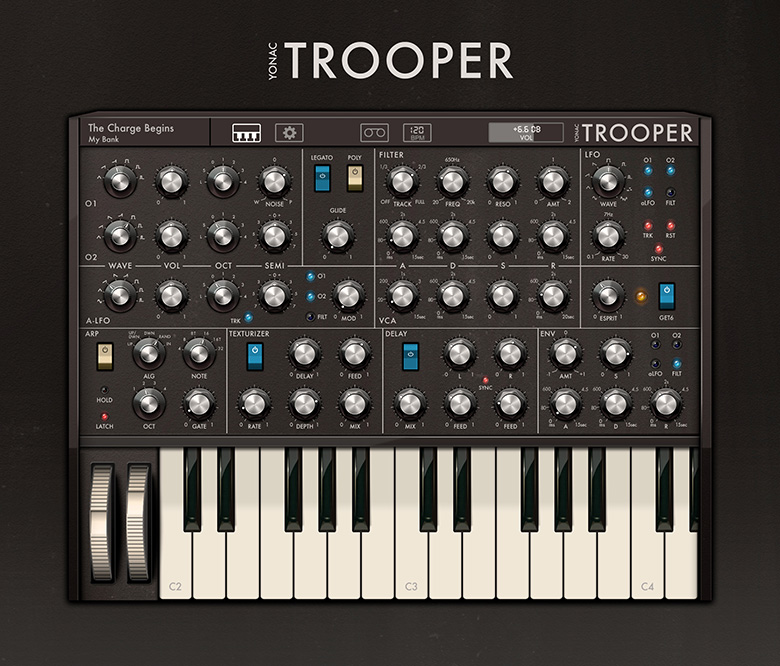
Many of Trooper's parameters are meant to interact and meld together in novel ways. The oscillator volumes, beyond acting as mere blend knobs, vary the characteristics of the basic signal depending on how far they're pushed — the emphasis is on warm, round basic tones with lots of variable harmonic content. The primary oscillators are backed by an audible LFO that's both a sound source and a wide frequency-range modulator, letting FM-based sounds combine with traditional waveforms. A pink/white noise generator helps out pads and percussion, insidiously changing tonality when added in small amounts.
A new filter implementation complements the pugnacity of the signal generators — in its middish settings, the resonance can be characterized as "throaty." The filter is capable of self-oscillating and can be controlled via the keyboard. The mated ADSR envelope is shaped to provide tonal "immediacy" and smooth frequency shifts. The output stage features a virtual VCA that imparts tones colloquially termed as fat, with extra modulation from a non-audible LFO and a dedicated envelope. The Esprit parameter deploys some of Trooper's "special sauce," while Get6 is a one-touch ticket to big, mix-filling synth sounds.

The arpeggiator inspires rhythms with five algorithms, variable note value, octave range, and gate. The Texturizer purveys a wide range of modulation effects that include chorus, flanging, variable comb, resonant delay, and stereo imaging. The BPM-syncable two-tap delay has time and feedback controls per channel, tuned a little darker than our usual offerings. Trooper can run in monophonic or polyphonic mode, the latter providing up to 12 voices, with legato available in either mode.

The robust MIDI implementation includes MPE support, and the synth can I/O MIDI performance data. The MagTouch virtual controller lets you play and record over the MPE protocol in AUv3 hosts that support it. MIDI Learn is made easy via a visual interface, and users can save, patch-link, and share MIDI CC maps, with Bluetooth MIDI input also supported. The AUv3 implementation lets you run multiple instances of Trooper in your DAW, with a fluid UI that accommodates a wide variety of screen sizes and view configurations, including iPad portrait layout.
Included are over 250 presets ranging from deep basses to weird so-and-so's, cataloged and shared with the powerful YPAT2 system. The standalone app provides a "Tapedeck" to record, save, and share your ideas on the quick, with a built-in looper, tap tempo, MIDI clock syncing, and a metronome with configurable time signature. DSP runs in high-resolution 64-bit, with native processing at up to 96kHz.

